
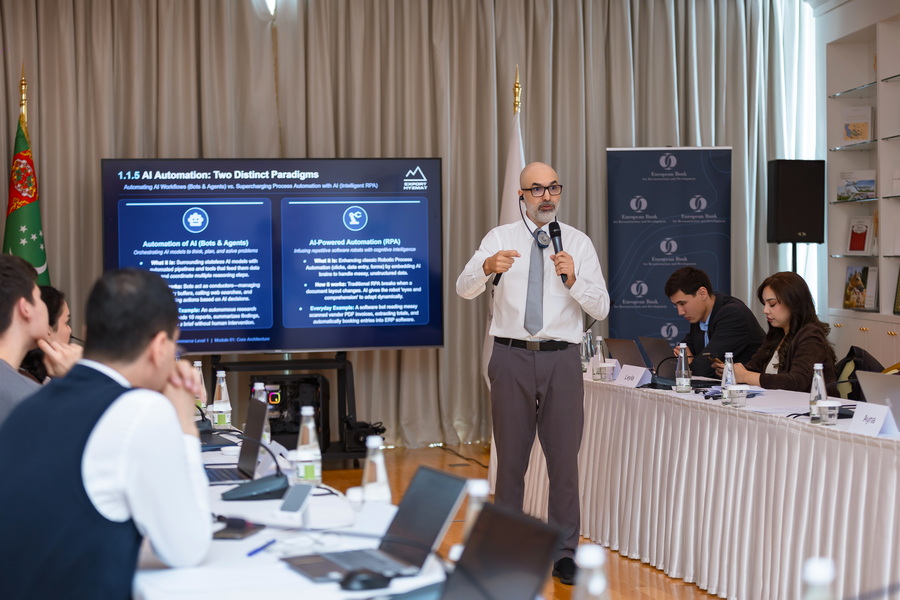
The European Bank for Reconstruction and Development (EBRD) training programme “Export Promotion for Local Consultants in Turkmenistan”, delivered jointly with Export Hyzmat, has concluded in Ashgabat. The second module of the training – “E-Commerce, Artificial Intelligence and Agentic Commerce in Export Development” – was held on 16-18 November 2026 and completed the training cycle envisaged by the programme. Both modules were led by Mohamed Es Fih, a trainer from France with more than twenty years of experience in international marketing, e-commerce and export digitalization.
Two modules – two sides of one task
The training programme was designed as a sequential course – moving from understanding the market to the tools for working in it. The first module, held on 21-23 October, covered export marketing, product promotion, finding distributors and relationships with foreign partners. The second added a digital dimension: how to organise sales in the online environment and make products visible on the internet. Together, the two modules covered the core questions an enterprise faces when entering foreign markets – strategy, partners, online channels and product presentation. The link between the modules was also visible in class: the trainer showed how an AI agent can search LinkedIn for potential importers, continuing the theme of finding buyers from the first module.
Three days of digital practice
On the first day, participants studied the fundamentals of artificial intelligence (AI) and agentic commerce – a model in which AI agents work on both sides of a transaction: helping sellers run their stores and helping buyers search for, compare and choose products. The practical part was devoted to building and configuring elements of an online store using AI tools and the “vibe coding” approach, in which a task is described in plain language and AI helps write the code. Each participant received a training online store and managed it through an AI agent using plain text commands: adding products, changing prices, and setting up taxes and shipping. The second day focused on internal processes. Participants looked at how to structure company data and describe business processes in BPMN notation so that AI tools can work with them. In practice, they used AI to add new fields to product cards, such as the HS code, and to populate the catalogue. The third day was devoted to the external side of the store: web design, publishing content optimised for search engines (SEO), and attracting traffic from AI services, through which buyers increasingly search for products.
What it offers consultants and enterprises
Work with an exporting enterprise rarely comes down to a single task. A company needs a market-entry strategy, an understanding of how to find buyers and distributors, and – increasingly – a presence in online trading channels. Here the knowledge from the two modules complements each other: first the consultant helps the enterprise define its target markets and its approach to promotion, then move on to practical steps – presenting products online so that foreign buyers can find and understand them, putting product data in order, automating individual processes, and making the site visible not only to search engines but also to AI services and to buyers’ AI agents, which select suppliers by criteria including HS codes, certifications and stock availability.
The value of such training is also noted by the enterprises themselves.
“When you have a consultant nearby who understands not only our product but also how to sell it abroad online, it becomes much easier for an enterprise to take its first steps in foreign markets,” says Jennet Hamrayeva, export manager at Tibet Turkmen. “Export marketing and e-commerce are no longer separate topics: today it matters that a single specialist understands both market-entry strategy and digital tools. We thank the EBRD and Export Hyzmat for organising such a programme, and the trainer Mohamed Es Fih for the practical knowledge we will be able to apply in our work with foreign buyers.”
Significance for Turkmenistan
The training programme was aimed at developing expertise within the country – training consultants who know local enterprises and can support them on the path to foreign markets. Specialists who command both export marketing and the skills of working with e-commerce and AI can become an accessible source of professional support for producers. This is particularly important for companies that are only starting out in export: they need help both in choosing a strategy and in the practical work with digital channels. Local consultants trained in both areas will help Turkmen enterprises prepare more confidently to operate in international markets.

