
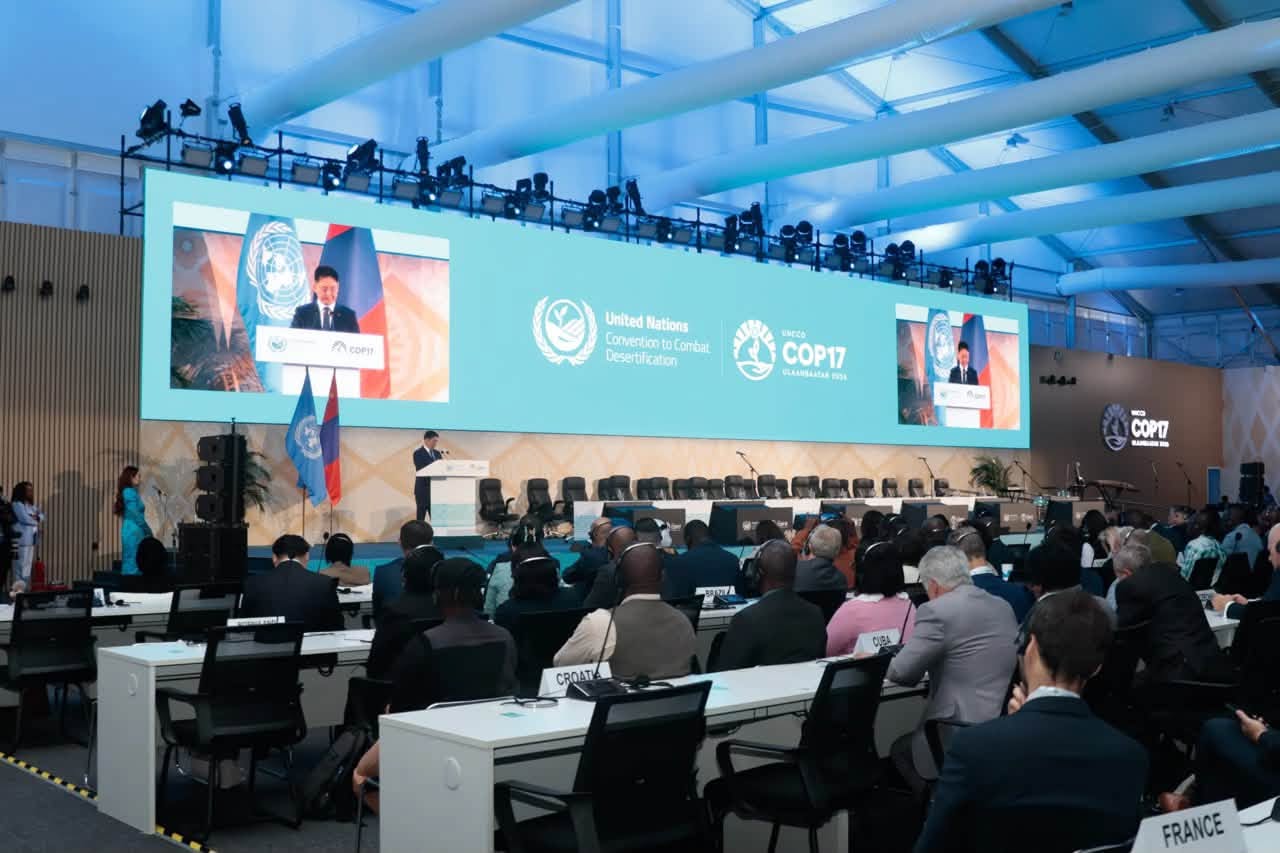
At the 17th session of the Conference of the Parties to the UN Convention to Combat Desertification (COP17), which is taking place in Ulaanbaatar, Tajikistan presented its experience in the field of sustainable land resource management.
A session of the Interregional group “Central Asia – Russia” took place in the Russian pavilion at COP17. Representatives of countries in the region participated in the discussion, including the Chairman of the Committee for Environmental Protection of Tajikistan Bahodur Sheralizado.
Participants discussed the problems of land degradation, the development of innovations in the environmental sphere, and further cooperation among countries in the region.
The work of the Interregional group “Central Asia – Russia” has been ongoing since 2019 and is aimed at the exchange of scientific data, technologies, and practical experience to achieve the goals of the UN Convention to Combat Desertification.
Three joint reports on land resources
One of the main results of the group’s work was the preparation of three joint publications created by experts from Central Asian countries and Russia.
Among them is a regional overview for Central Asia as part of the flagship report Global Land Outlook. As noted by the coordinator for Central and Eastern Europe and the group of Central Asian countries of the UN UNCCD Secretariat Nadezhda Dementyeva, such an overview for Central Asia was prepared for the first time.
Research was also presented on achieving land degradation neutrality in Central Asia and on carbon farming.
Digitalization of land monitoring
The Chairman of the Committee for Land Resource Management of Kazakhstan Murat Temirzhanov spoke about the implementation of digital solutions for monitoring the condition of lands.
According to him, Kazakhstan has completed full digitalization of lands, and an information system is now being created that combines data on soil quality, agrochemical condition, vegetation cover, and other indicators. In the future, artificial intelligence technologies are planned to be integrated into the system.
Tajikistan also considers the development of digital monitoring of natural resources as one of the directions of environmental policy.
Tajikistan’s experience
In recent years, the country has faced problems of land degradation, soil erosion, climate change, and water scarcity.
According to data from the international initiative WOCAT, Tajikistan ranks first in Central Asia in the number of registered sustainable land use technologies — 124 practices. These solutions include methods for soil and water conservation, restoration of degraded areas, and sustainable management of agricultural lands.
Common challenges for the region
Meeting participants emphasized that land degradation, droughts, and dust storms are transboundary problems that require joint solutions.
Advisor to the President of Uzbekistan on Ecology Aziz Abdukhakim noted the need to create monitoring and early warning systems for environmental threats.