
The railway corridor holds strategic value because it provides access to regions that border the northern parts of the country and the new line will help in the quick transportation of defence personnel, equipment, and supplies when needed.
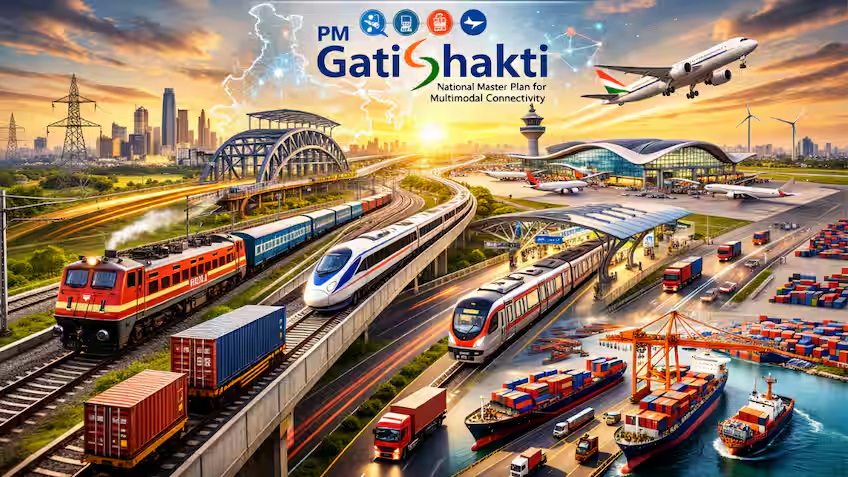
The Department for Promotion of Industry and Internal Trade hosted the Network Planning Group (NPG), which conducted its 109th meeting at its facility. The meeting evaluated multiple key infrastructure projects that were part of the PM GatiShakti initiative.
Focus on enhancing national transportation and connectivity
The project intended to enhance national transportation systems through improved connection points, which would enable faster and more efficient freight and passenger travel throughout the country.
Projects reviewed from rail, metro, and aviation
The meeting included officials who assessed four important projects that different ministries had developed. The assessment included two railway initiatives from the Ministry of Railways, one metro system extension from the Ministry of Housing and Urban Affairs and one airport development initiative from the Ministry of Civil Aviation.
The projects underwent evaluation to confirm their compliance with GatiShakti Master Plan integrated planning standards, which require efficient logistics systems and effective last-mile connections and inter-agency government collaboration.
Third railway line between Jalandhar Cantt and Jammu Tawi
The meeting focused on one main recommendation, which involved building a third railway line that would connect Jalandhar Cantt with Jammu Tawi. The project will extend about 210.75 kilometres through the three regions of Punjab, Himachal Pradesh and Jammu and Kashmir.
The new line will include 27 stations and pass through important districts such as Jalandhar, Hoshiarpur, Kangra, Pathankot, Kathua, and Samba. The project aims to increase railway capacity on this important route. The system will enable more efficient transportation of both passengers and freight.
The railway corridor holds strategic value because it provides access to regions that border the northern parts of the country. The new line will help in the quick transportation of defence personnel, equipment, and supplies when needed. The system will benefit the local economy through its capacity to enhance agricultural product and, construction material and general goods transportation.
The third railway project, which connects Manikpur with Itarsi through Madhya Pradesh and Uttar Pradesh, stands as another crucial undertaking that the committee evaluated.
The proposed line will cover about 518.5 km and pass through districts such as Chitrakoot, Satna, Maihar, Katni, Jabalpur, Narsinghpur, and Narmadapuram. The railway section already carries heavy passenger and freight traffic because it connects northern India with central India.
The additional line will help increase railway capacity and reduce congestion on the route. It will allow more trains to operate smoothly and improve the reliability of railway services. The project will also support industries, goods transport, and tourism in the region while strengthening the overall railway network.
Greenfield Airport at Doloo, Silchar to boost regional connectivity
The meeting also reviewed a proposal to build a new greenfield airport at Doloo in Silchar, Assam. The airport will be situated adjacent to National Highway-27 and is designed to serve the increasing air travel requirements of the local population. The new airport will provide modern aviation infrastructure and improve connectivity for people living in Silchar and nearby areas.
The airport will result in economic advancement for the Cachar district after its construction is completed. Better air connectivity can encourage tourism, increase business opportunities, and support sectors such as logistics, hospitality, and urban development.
The extension of Surat Metro Corridor II in Gujarat became another project that the team discussed. The proposed extension will run 4.4 km from Saroli to the Mumbai–Ahmedabad High-Speed Rail corridor. The elevated metro line will include three stations, with the possibility of adding two more in the future.
The metro extension will serve as a feeder system that connects to the high-speed rail corridor and enables passengers to switch between metro and bullet train services. The plans will establish feeder bus systems together with enhanced facilities for pedestrians, which will connect to the final destination. The project will enhance urban transit in Surat while creating a more efficient and environmentally friendly transportation system.
The meeting reviewed multiple projects that will improve India’s transportation system through better logistics operations and economic development for various parts of the nation.