
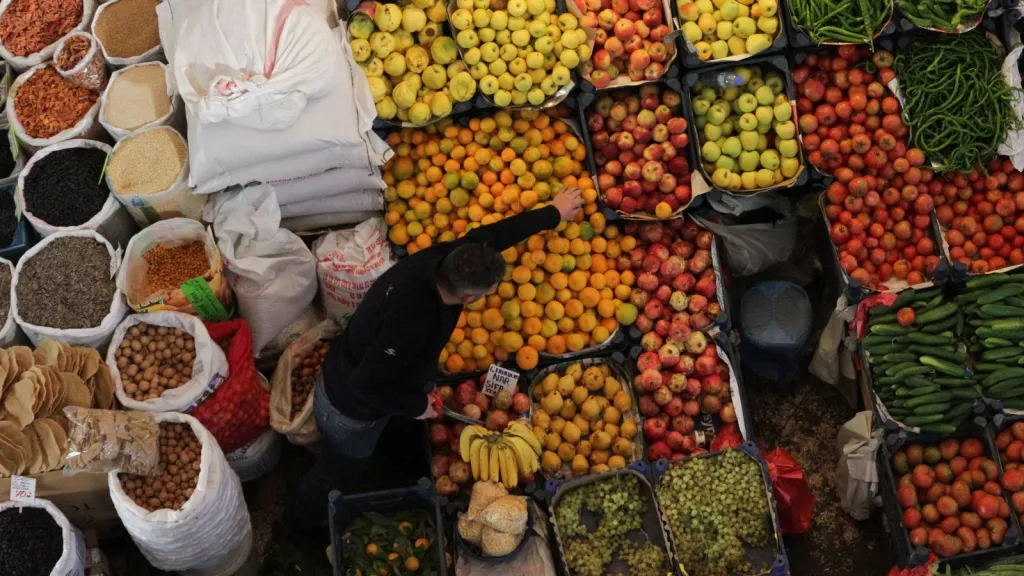
Prices for Indian households rose 4.45% in July, little changed from the 4.38% increase seen in June, although inflation for war-impacted categories remained elevated. According to data released Wednesday by the Ministry of Statistics and Programme Implementation (MoSPI), food inflation in the country rose to 5.52% last month from 5.32% in June, while restaurants and cafes continued to charge diners higher prices.
Key food items also posted a sharp increase in prices. Onion inflation, for instance, jumped to 22.54% in July from 4.73% in June despite an unfavourable base effect as prices rose 26% on a month-on-month basis.
There was a similar movement elsewhere. While potato prices were down 17% on a year-on-year basis, they were up 8% in July compared to June. Tomato, on the other hand, was down 5% on-year and 4% on-month. Overall food inflation rose to 5.52% from 5.32% in June. It was as low as 2.13% in January.
“The increase in food inflation was driven by the cereals, meat & fish, dairy & eggs, and sugar and ready-made food categories,” said Barclays economists Aastha Gudwani and Amruta Ghare. “We note accelerating momentum in cereals and ready-made food CPI in the past three months, while the sequential increase in meat and fruits CPI in July was more than expected.”
According to Madan Sabnavis, Bank of Baroda’s Chief Economist, food and overall retail inflation will continue to increase given the sub-par rains and area under cultivation.
“While monsoon has recovered substantially in July, there has been news of crop damage due to excess rains. This combined with a longer cropping period and hence, harvest will push up prices of pulses in particular,” Sabnavis added.
According to economists, inflation in August – data for which will be released on September 14 – will probably increase slightly to 4.5-4.7%. After August, as the base effect turns unfavourable, inflation is seen crossing 5%. The Reserve Bank of India (RBI), which last week left its policy repo rate unchanged at 5.25%, expects headline retail inflation to average 4.7% in July-September, 5.9% in October-December, 5.5% in January-March 2027, and 5.3% in April-June 2027.
“Persistent upside risks are posed by geopolitical tensions and El Nino weather pattern, though some improvement in the latter could be visible in the August print. Crude price volatility is expected to continue with oil likely to hover around $80-85/bbl in the coming weeks,” said Megha Arora, Director at India Ratings & Research.
While not a part of the ‘food and beverages’ category of the Consumer Price Index (CPI), prices charged by restaurants and cafes rose by almost 8% in July compared to the same month last year after increasing by around 7% in June. Eateries have been passing on higher commercial LPG prices to their customers.
On the fuel front, inflation has begun to stabilise, albeit at elevated levels, for petrol and diesel.
Core inflation, or inflation excluding food and fuel items, remained unchanged at 3.9%, as per calculations by The Indian Express. The RBI has forecast it will average 4.3% in 2026-27. So far, it has averaged 3.8% this financial year. According to Arora of India Ratings, the stable core inflation print is indicative of absence of demand push to inflation and may come in lower than the RBI’s forecast.
“In our view, while immediate policy tightening is unlikely, elevated inflation projections for Q3 FY27 through Q1 FY28, suggest that the next move on rates is going to be a hike. Evidence of a generalisation in inflationary pressures in the next few months could result in a rate hike in the December 2026 meeting,” said Aditi Nayar, ICRA’s Chief Economist.