
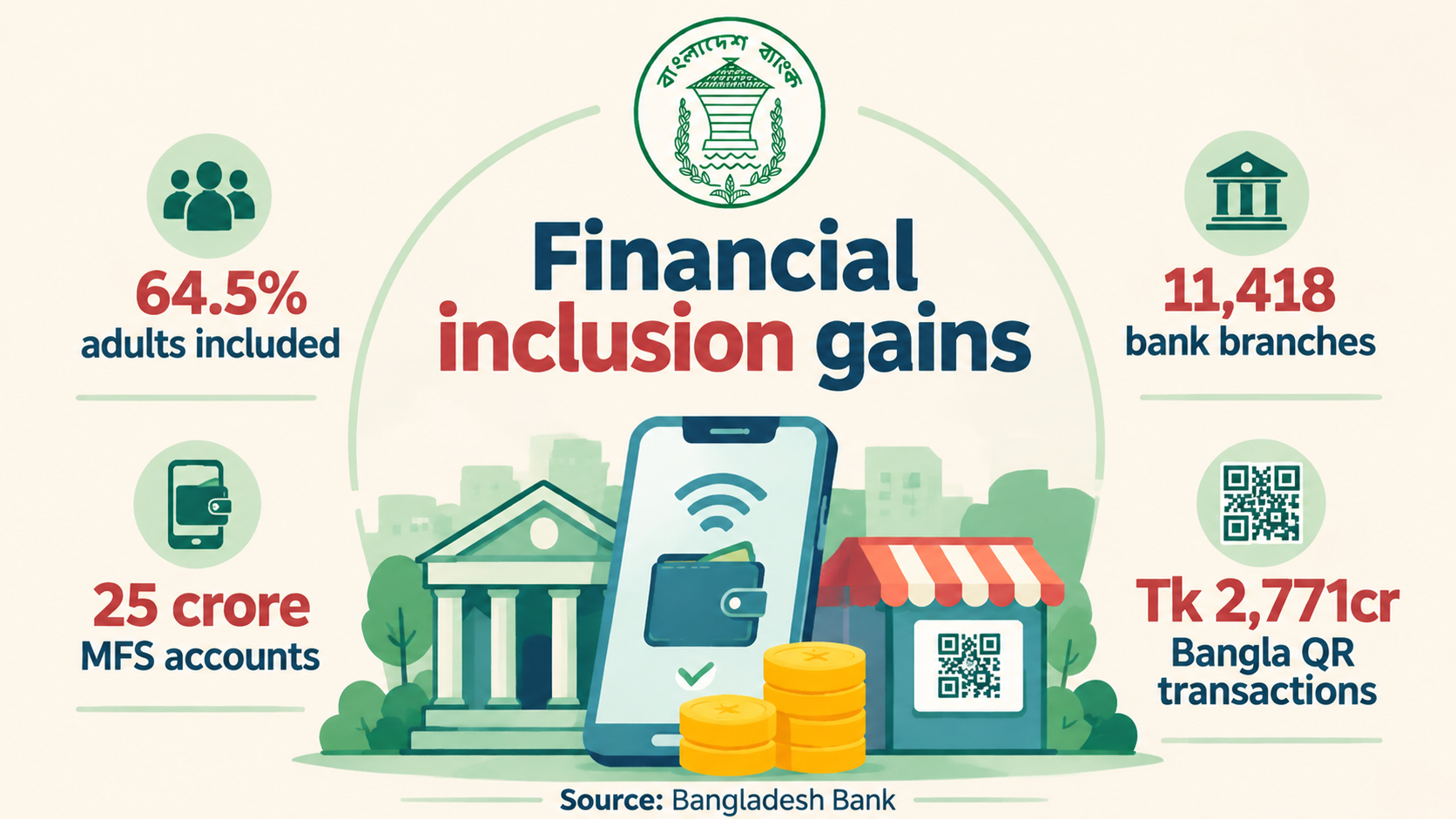
Bangladesh has made notable strides in expanding its formal financial ecosystem, with the National Financial Inclusion Survey 2025 revealing that 64.5 percent of the adult population is now formally financially included.
These adults hold an account with at least one type of formal financial institution, including banks, mobile financial service (MFS) providers, microfinance institutions, insurers, finance companies or capital market intermediaries.
The findings are highlighted in the Financial Inclusion Report 2025 published by Bangladesh Bank.
The comprehensive report outlines the nation’s progress during the final stages of the National Financial Inclusion Strategy (NFIS) 2021-2026, showcasing significant advancements driven by mobile financial services, agent banking and structural policy frameworks.
MFSs maintained the largest customer base, highlighting their significant role in expanding access to digital financial services.
An analysis of the data showed that financial inclusion is higher among men than women. This gender gap remains consistent across both rural and urban areas.
MFS accounts expanded to 25 crore, including 10 crore female accounts, backed by an extensive network of over 20 lakh active agents. Annual MFS transactions surpassed Tk 2 lakh crore in 2025.
Mobile financial services, despite operating without a traditional branch network, compensate for this through an extensive agent base exceeding 15 lakh touch points, reflecting the sector’s reliance on agent-driven, low-cost distribution to reach a wide population base.
Banks maintain the most extensive physical network, with 11,418 branches and full online connectivity, underscoring their continued position as the backbone of formal financial access.
Agent banking maintains 20,501 outlets serving 2.5 crore accounts, with 86 percent of these outlets and 85 percent of the accounts concentrated in rural areas, predominantly driven by private commercial banks and Islamic banks.
At the end of 2025, merchant onboarding reached approximately 9.63 lakh under Bangla QR, a national interoperable QR code payment standard introduced by Bangladesh Bank to establish a unified, secure and cost-effective merchant payment ecosystem.
During 2025, Bangla QR processed approximately 64 lakh merchant payment transactions, amounting to Tk 2,771 crore.
An analysis of the data showed that financial inclusion is higher among men than women. This gender gap remains consistent across both rural and urban areas.
The inclusion rate increases with education, as account ownership rises from 55.1 percent among adults with no formal education to nearly 90 percent among those with tertiary-level education.
Across the financial sub-sectors, a highly uneven growth pattern was observed in 2025.
The number of accounts at finance companies rose by 19 percent and those at banks by 10 percent compared to the previous year.
MFSs and microfinance institutions posted moderate growth of 8 percent and 7 percent, respectively.
Capital market intermediaries remained broadly stable, recording a marginal decline of around 0.6 percent.

