
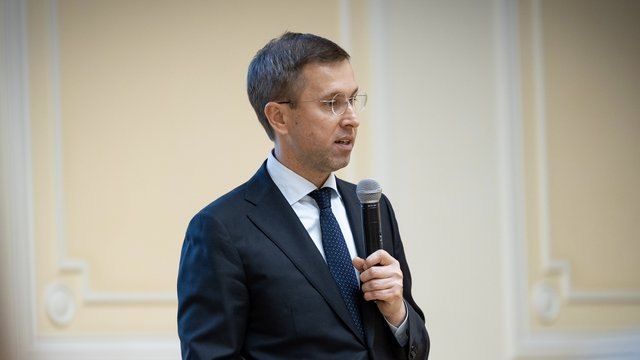
Prime Minister of Ukraine Serhiy Koretsky has called on the business community to prepare in advance for the most critical scenarios regarding enemy attacks and economic challenges.
“When we talk to founders and top management, I’ve sensed a certain attitude that ‘it will somehow blow over.’ Perhaps I won’t be targeted by missiles or drones, perhaps my sector won’t be touched. Therefore, first: I would strongly ask and recommend thinking according to the most critical scenario of events. Thinking ahead about alternative production sites: who you can cooperate with, where you can make a private label if we are talking about consumer goods, if your enterprise is hit. How to talk in advance with suppliers, perhaps even for imported goods, how to conclude framework contracts and be ready rather than doing it all later. Looking at alternative premises for relocation, for restoration. In other words, think in the most critical scenario. It is better to be ready for this and have it not happen than to find oneself in an unexpected situation,” Koretsky said at the 12th Kyiv International Economic Forum (KIEF) themed “People. Business. Economy. What’s Next?” in Kyiv on Monday, as reported by an Interfax-Ukraine correspondent.
According to the Prime Minister, enemy strikes have already caused over $7.7 billion in losses, with more than 1 million square meters of various types of real estate, both state and private, destroyed or damaged. Significant destruction has hit energy, metallurgy, logistics, processing enterprises, retail, and other sectors.
“Considering these losses, considering the strikes, we already see that by the end of the year the state budget will underfulfill its plans and forecasts by about $1.5 billion. That is the baseline forecast we have today,” he stated.
At the same time, he emphasized that despite all this, the country’s economy continues to function.
“If we think in terms of PnL (Profit and Loss statement), allocating a lot of funds to support business is impossible. There is no such PnL, because we can only cover one-third of the budget. Even realizing, clearly realizing this, we live even on a cash flow principle and in a certain way go all-in, allocating certain funds to support programs, to various subsidies, to grant programs. Because we realize that without this support, business – small, medium, and large in particular – cannot be sufficiently resilient to counter enemy attacks. And this is the conscious logic and tactics of the government,” Koretsky said.
The Prime Minister stressed that the government will continue programs that have proven their effectiveness, notably the “Affordable Loans 5-7-9%” program. He noted that since the program’s inception, UAH 580 billion has been issued, with the current loan portfolio principal standing at around UAH 200 billion. He recalled the recent decision allowing large businesses to receive about UAH 1 billion “in one hand per group of companies” at a preferential interest rate of around 10%.
“The 2026 budget allocated UAH 18 billion. We are expanding this program and see that by the end of the year it will be UAH 22 billion. We currently have a certain deficit on four billion, but one way or another we will cover it, because we consider this to be one of the fundamentally important, correct programs that genuinely supports business,” the Prime Minister said.
He also pointed out the necessity of establishing a war risk insurance and damage compensation system. Koretsky recalled the proposal to create a special fund in the budget with an initial state contribution of $1 billion, which partners would double or triple.
“How will this work further? A simplified procedure. Compensation within 30 days after processing. And the tariff for this insurance risk must be very basic, symbolic, we are aiming at approximately 2%. And the maximum damage compensation will be about $5 million in one hand,” the Prime Minister detailed.
Koretsky also stated that there is currently no consensus or support for increasing the Value Added Tax (VAT) from 20% to 21% to fund this special fund.
“There is no consensus among big and medium business, there is no support in parliament yet. We are looking for other mechanisms. We will see how the budgetary process proceeds in parliament and build from that. But we have no other path, we must find the instrument. Together we will see what we can contribute,” Koretsky said.